Mai-Huong T. Ngo, Ph.D.
Department of Biochemistry and Molecular Cell Biology, College of Medicine, Taipei Medical University, Taipei, Taiwan
Innovations in T cell immunotherapy
T cell–based therapies have emerged as a transformative class of immunotherapeutic strategies in oncology, harnessing the cytotoxic potential of lymphocytes to selectively eliminate malignant cells. Among these, chimeric antigen receptor T cells (CAR-T) and bispecific T cell engagers (BiTEs) represent landmark advances, enabling either genetic reprogramming of patient-derived T cells or antibody-mediated redirection of endogenous T cells toward tumor antigens. While both approaches have demonstrated remarkable efficacy in hematologic malignancies, their application in solid tumors remains challenged by issues such as antigen heterogeneity, immunosuppressive microenvironments, and systemic toxicities including cytokine release syndrome.
To overcome these limitations, novel modalities such as bispecific antibody–armed T cells (Armed-T) are being developed, wherein functionally selected T cell subsets are expanded ex vivo and armed immediately prior to infusion. This strategy ensures the delivery of a large population of tumor-targeting effector cells with reduced risk of nonspecific activation, thereby offering a promising avenue for advancing T cell–based immunotherapy in solid cancers [1-5].
Strengths and limitations of CAR‑T, BiTEs, and Armed‑T cells
CAR‑T, BiTEs, and Armed‑T cell therapies each present distinct strengths and limitations in cancer immunotherapy. CAR‑T cells offer durable remissions in hematologic malignancies due to their long‑term persistence, but they require complex, costly ex vivoengineering and carry risks of cytokine release syndrome and neurotoxicity, with limited efficacy in solid tumors.
BiTEs, by contrast, are off‑the‑shelf bispecific antibodies that provide immediate availability and scalable production, yet their short half‑life necessitates continuous infusion and their efficacy is often less durable, relying heavily on the patient’s endogenous T‑cell fitness. Armed‑T cells represent a hybrid approach, combining ex vivo expansion with antibody arming to enhance tumor targeting and reduce cytokine toxicity; however, they remain experimental, with moderate logistical complexity and uncertain long‑term persistence. The features of these T cell-based therapies were detailed in Table 1[1-5].
Outlook of T cell-based therapy
The outlook for T cell–based therapies in oncology is highly promising, with ongoing advances poised to expand their efficacy beyond hematologic malignancies into solid tumors. Continued refinement of chimeric antigen receptor T cells (CAR-T) and bispecific T cell engagers (BiTEs) is addressing challenges such as antigen heterogeneity, tumor microenvironment suppression, and systemic toxicities.
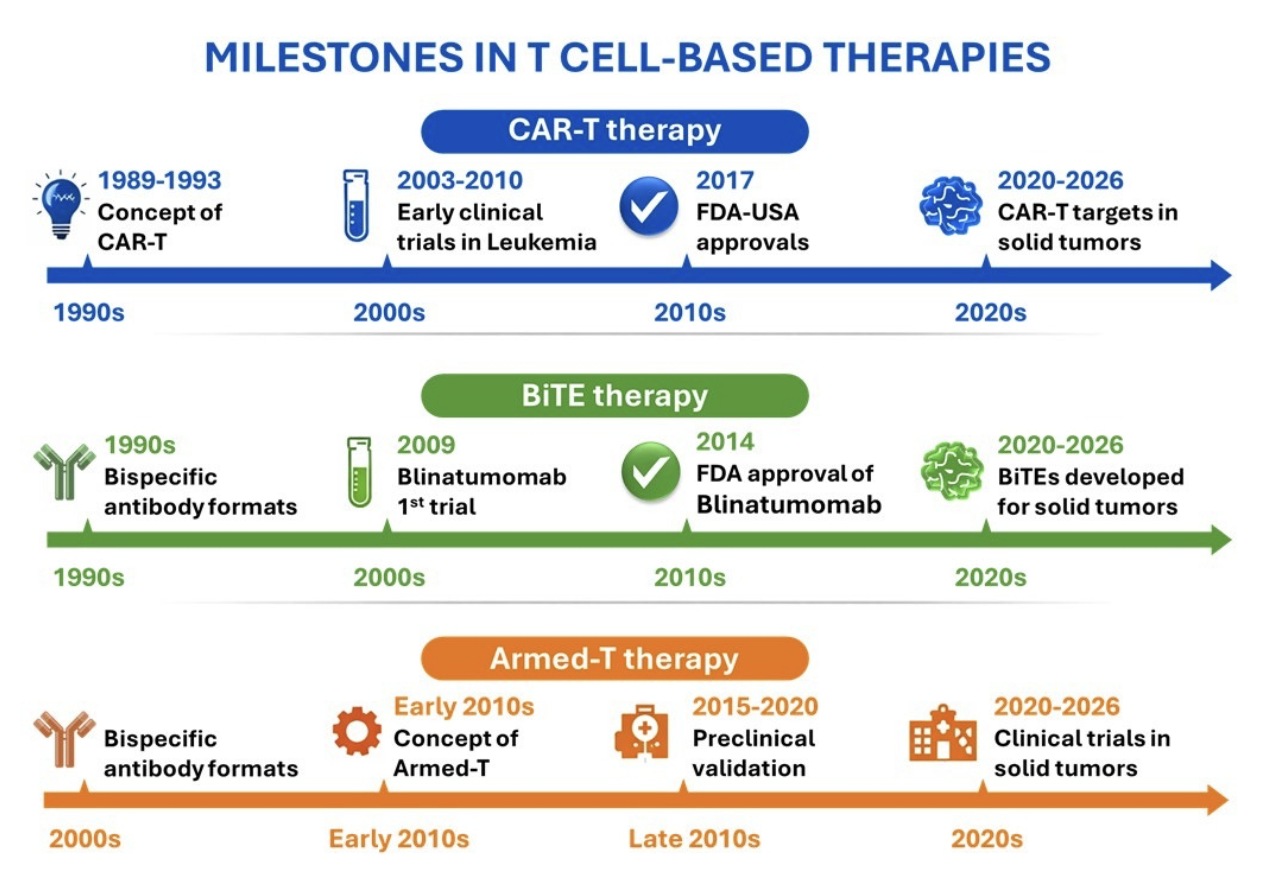
Figure 1. Strengths and limitations of CAR‑T, BiTEs, and Armed‑T cells
Emerging strategies, including bispecific antibody–armed T cells (Armed-T), armored CAR-T cells, and combination regimens with checkpoint inhibitors, are designed to enhance persistence, specificity, and safety. Moreover, innovations in gene editing, synthetic biology, and ex vivo expansion protocols are expected to generate more potent and durable effector populations. As these modalities progress toward clinical translation, T cell–based therapies are anticipated to become integral components of precision oncology, offering curative potential for previously intractable cancers [1-5].
Challenges of T cell-based therapy
Despite the encouraging outlook, T cell–based therapies continue to face significant challenges that limit their broader clinical application. A major obstacle is the immunosuppressive tumor microenvironment, which impairs T cell infiltration, persistence, and cytotoxic activity. Antigen heterogeneity and loss further contribute to therapeutic resistance, while systemic toxicities such as cytokine release syndrome (CRS) and neurotoxicity remain pressing safety concerns. Technical hurdles also persist, including the complexity and cost of ex vivo engineering for CAR-T cells, and the non-selective activation of T cell subsets by BiTEs, which can compromise efficacy and increase adverse effects. Moreover, manufacturing scalability, patient accessibility, and regulatory standardization present additional barriers to widespread adoption. Addressing these multifaceted challenges will be critical to realizing the full potential of T cell–based therapies in oncology [1-5].
Table 1. The advantages and disadvantages of CAR‑T, BiTEs, and Armed‑Tcell therapies
| Feature | CAR‑T Cells | BiTEs | Armed‑T Cells |
| Mechanism of Action | Patient T cells are genetically engineered ex vivo to express chimeric antigen receptors that recognize tumor antigens. | Recombinant bispecific antibodies link CD3 on endogenous T cells to tumor antigens, redirecting T cells in vivo. | Functional T cells are selected and expanded ex vivo, then armed with bispecific antibodies immediately before infusion. |
| Manufacturing Process | Complex, individualized cell engineering and expansion (weeks). | Off‑the‑shelf biologic drug; no cell manipulation. | Moderate complexity – ex vivo expansion and antibody arming of selected T cells. |
| Administration | Single infusion of engineered cells. | Continuous or repeated infusion due to short half‑life. | Single or limited infusions of pre‑armed effector T cells. |
| Advantages | Durable remission; long‑term persistence; high efficacy in hematologic malignancies. | Easy logistics; scalable; immediate availability. | Controlled activation; reduced cytokine release; improved targeting in solid tumors. |
| Limitations | High cost; severe cytokine release syndrome (CRS); limited efficacy in solid tumors. | Short half‑life; non‑selective activation of all CD3⁺ subsets; potential CRS. | Requires ex vivomanipulation; still under clinical evaluation. |
| Representative Example | Tisagenlecleucel (Kymriah), Axicabtagene ciloleucel (Yescarta) | Blinatumomab (CD19/CD3) | Experimental platforms targeting EGFR, HER2, GPC3. |
| Clinical Focus | Hematologic malignancies (B‑ALL, DLBCL). | Hematologic and emerging solid tumors. | Solid tumors with defined antigen targets. |
| B‑ALL: B-cell acute lymphoblastic leukemiaCRS: severe cytokine release syndromeDLBCL: Diffuse large B-cell lymphoma | |||
Global market perspective
Parallel to scientific advances, the global market for T cell–based therapies is undergoing rapid expansion. CAR‑T therapy is projected to grow from USD 10.92 billion in 2026 to USD 19.25 billion by 2034, at a Compound Annual Growth Rate (CAGR) of 7.34%, with North America maintaining a dominant share of over 70% and Asia‑Pacific emerging as the fastest‑growing region.
In contrast, the BiTEs market, though smaller in absolute value, is expanding at a much faster pace, expected to rise from USD 1.94 billion in 2026 to USD 4.18 billion by 2030 at a CAGR of 21.2%. This growth is driven by antibody engineering innovations, expansion into solid tumor indications, and strategic partnerships, exemplified by the FDA approval of Amgen’s IMDELLTRA (tarlatamab‑dlle) in 2024.
Together, these trends highlight a robust global trajectory in which CAR‑T therapies dominate revenue while BiTEs reshape the immunotherapy landscape through accelerated adoption and diversification [6-11].
References
- Rafei, H., R. Upadhyay, and P. Sharma, A guide to CAR T cell therapies: development, current status and future prospects. Nature Reviews Immunology, 2026.
- Zi, G., et al., Advances and prospects in cell therapy for cancer: explorations from T cells to stem cells. Signal Transduction and Targeted Therapy, 2026. 11(1): p. 255.
- Adly, A.S., et al., CAR-T Cells: Current Status, Challenges, and Future Prospects. (2688-2663 (Electronic)).
- In, H., et al., Immune Cell Engagers: Advancing Precision Immunotherapy for Cancer Treatment. Antibodies (Basel), 2025. 14(1).
- Dewaele, L. and R.A. Fernandes, Bispecific T-cell engagers for the recruitment of T cells in solid tumors: a literature review. Immunother Adv, 2025. 5(1): p. ltae005.
- CAR T-Cell Therapy Market Report 2026-2031, By Product, Indication, and Geo
- CAR T-cell Therapy Market Size Report, 2026-2033
- CAR T-cell Therapy Market Size, Growth Outlook 2025 – 2034
- Bispecifics/BITE Market Insights, Drugs and Forecast – 2034
- Bispecific T-Cell Engager (BiTE) Market Size to Hit USD 6.54 Billion by 2034 | CAGR 18.4%
- Global Bispecific T-Cell Engager (BiTE) Therapeutics Market: 15.8%…


Leave a Reply