The ACTO Times, Editorial Office
Abstract
China has developed one of the world’s most active cell and gene therapy research environments, accompanied by a regulatory system that has evolved rapidly over the past decade. The framework has often been described as “dual-track,” comprising a drug-product pathway administered by the National Medical Products Administration and a medical-technology or investigator-initiated research pathway overseen primarily by health authorities. However, these pathways should not be understood as interchangeable routes for the same product. Standardized cell and gene therapy products intended for commercial development are generally regulated as drugs, whereas the technology pathway is intended for specified biomedical innovations that do not appropriately fit conventional product development. A major transition occurred with the promulgation of the Administrative Regulation on Clinical Research and Clinical Translation of New Biomedical Technologies, which entered into force on May 1, 2026. The regulation establishes legally binding requirements for research filing, institutional qualification, ethical review, participant protection, clinical translation, long-term follow-up, supervision, and liability. This review summarizes the development of China’s cell and gene therapy regulation, clarifies the relationship between the product and technology pathways, and identifies areas requiring continued regulatory development.
Keywords: cell therapy; gene therapy; China; regulation; clinical research; advanced therapy medicinal products
Introduction
Cell and gene therapies encompass a diverse group of interventions, including immune-cell therapies, stem-cell products, genetically modified cells, in vivo gene therapies, and other technologies acting at the cellular or molecular level. Their potential clinical benefits are accompanied by distinctive risks, including product variability, manufacturing complexity, insertional mutagenesis, prolonged biological activity, immune toxicity, tumorigenicity, and uncertain long-term outcomes. Regulatory oversight must therefore address not only conventional clinical safety and efficacy but also source materials, manufacturing consistency, potency, traceability, long-term monitoring, and institutional capability.
China’s cell therapy sector has expanded considerably, particularly in chimeric antigen receptor T-cell therapy, stem-cell research, and investigator-initiated clinical studies. Published analyses describe China as having a dual-track regulatory framework that supports both industry-sponsored drug development and institution-based clinical research [1–4].
Nevertheless, the expression “dual-track” can oversimplify the system. The two pathways have different legal objectives, evidentiary requirements, responsible authorities, and routes to clinical use. They should not be presented as parallel commercial options from which a developer may freely select.
Evolution of the regulatory framework
Earlier Chinese regulation of cell therapy developed through a combination of medical-technology administration and drug regulation. Institution-based research was particularly important for stem-cell and immune-cell interventions. In 2015, the former National Health and Family Planning Commission and the China Food and Drug Administration jointly issued the Administrative Measures for Stem Cell Clinical Research (Trial). These measures established institutional and project-filing requirements for stem-cell research and placed primary responsibility for research quality and participant protection on qualified medical institutions [5].
A more explicit product pathway emerged through the 2017 Technical Guideline for Research and Evaluation of Cell Therapy Products (Trial). The guideline applies to human living-cell products developed and submitted for registration as drugs and sets general expectations for risk control, pharmaceutical development, nonclinical studies, and clinical evaluation [6]. It does not apply automatically to every clinical use of cells and expressly distinguishes drug-registration development from cell technologies managed under other pathways.
China subsequently issued more specialized technical guidance. These documents address clinical trials of immune-cell therapy products, nonclinical evaluation of gene therapy products, nonclinical studies of genetically modified cell therapies, in vivo gene therapy manufacturing, communication with regulators, and clinical pharmacology considerations [7,8]. The expanding guidance system reflects increasing recognition that cell and gene therapies cannot be evaluated adequately using requirements designed only for conventional small-molecule medicines.
Peer-reviewed documentary analysis has found that China has progressively developed regulatory functions covering clinical-trial authorization, marketing authorization, laboratory testing, inspection, licensing, and pharmacovigilance for advanced therapies [2,3]. However, researchers have also identified areas requiring further refinement, including greater coordination among regulatory functions, consistent implementation of technical standards, transparency, investigator-initiated research quality, and product-specific post-marketing surveillance [2–4,9].
The drug-product pathway
Cell and gene therapy candidates that possess a defined product form and are intended for standardized, reproducible, and potentially scalable production are generally developed under the drug regulatory pathway. The National Medical Products Administration, principally through its Center for Drug Evaluation, is responsible for the technical review of clinical-trial and marketing applications.
Under this pathway, the sponsor develops a defined investigational product and submits evidence on manufacturing, quality control, nonclinical safety, and the proposed clinical investigation. Product characterization may include identity, purity, viability, potency, genetic stability, vector-related attributes, sterility, adventitious-agent control, and comparability following manufacturing changes. The precise requirements depend on the nature of the therapy and are applied on a case-by-case basis [2,6–8].
Clinical development is conducted under the drug-registration system and must comply with applicable requirements for good clinical practice. Successful development may lead to national marketing authorization. Once authorized, the product remains subject to manufacturing supervision, pharmacovigilance, risk management, change control, and other life-cycle requirements.
China’s product pathway has supported substantial growth in industry-sponsored cell therapy trials and the authorization of several cellular immunotherapies.
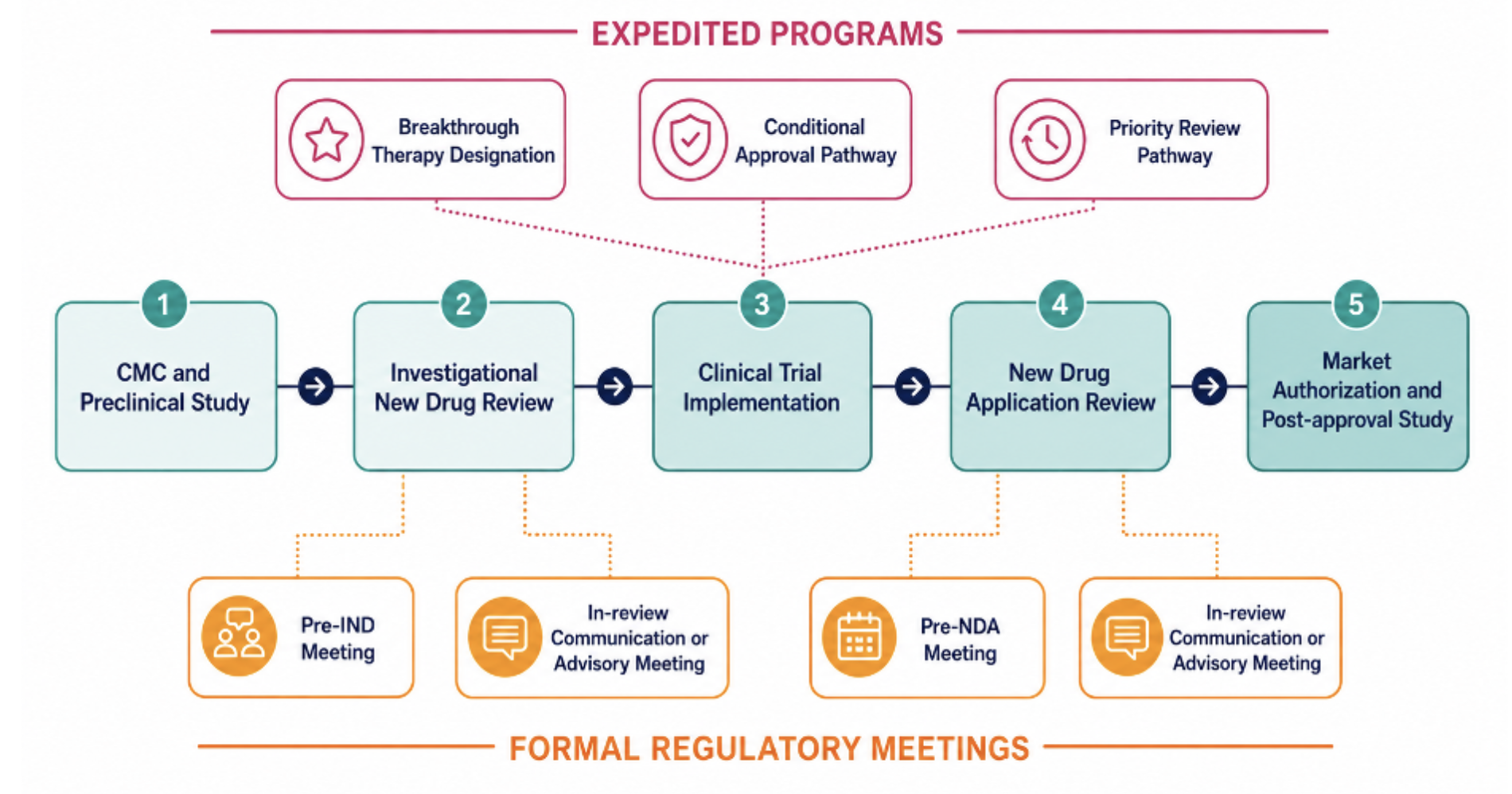
Figure 1. The review pathway for advanced therapy medicinal products (ATMPs) covers the full development lifecycle, beginning with chemistry, manufacturing, and controls (CMC) and preclinical evaluation, followed by investigational new drug (IND) review, clinical trial conduct, new drug application (NDA) assessment, marketing authorization, and post-approval studies. Common expedited regulatory mechanisms include priority review, breakthrough therapy designation, and conditional approval. Formal interactions with regulatory authorities typically occur through pre-IND and pre-NDA meetings, while additional in-review discussions or advisory meetings may be arranged when further clarification is required [2].
Nevertheless, most registered cell therapy studies in China have historically been investigator-initiated rather than industry-sponsored. An analysis covering clinical trials through August 2024 identified 2,794 cell therapy studies, of which approximately 90% were categorized as investigator-initiated trials [4]. The authors noted that these studies can generate useful exploratory evidence but may vary in manufacturing control, study design, data quality, and their suitability for supporting subsequent drug applications.
Post-marketing regulation is particularly important for therapies whose effects may persist for months or years. A comparative study published in 2024 concluded that China had introduced several relevant post-marketing requirements for cell and gene therapy products, but that dedicated guidance was less detailed than the corresponding systems examined in the European Union, United States, Japan, and South Korea [9]. This conclusion represents the situation assessed by the authors before implementation of the 2026 biomedical-technology regulation and should not be interpreted as an evaluation of the new framework.
The biomedical new-technology pathway
The most significant recent development is the Administrative Regulation on Clinical Research and Clinical Translation of New Biomedical Technologies, promulgated as State Council Order No. 818 and effective from May 1, 2026 [10]. It provides a statutory framework for clinical research and clinical translation of biomedical technologies that apply biological principles, act at the human cellular or molecular level, and have not yet been clinically applied in China.
Importantly, the regulation does not replace the drug or medical-device systems. Article 55 states that clinical trials undertaken to develop drugs or medical devices remain governed by the Drug Administration Law, the medical-device regulations, and related legislation [10]. The National Health Commission and National Medical Products Administration have consequently emphasized that institutions should select either the biomedical-technology pathway or the drug/device pathway according to the nature and intended development of the intervention [11].
Official implementation guidance further narrows the scope of technologies eligible for clinical translation through the new pathway. A technology must be included in the relevant clinical-research filing guidance list and generally must meet at least one of two conditions: it is highly individualized and no drug based on a similar mechanism has obtained domestic marketing authorization or entered a confirmatory clinical trial; or it treats a rare disease for which no drug with a similar mechanism and the same indication has obtained authorization or entered a confirmatory trial [12]. Technologies meeting the legal definition of a medical device are excluded from this clinical-translation route.
The distinction is therefore not simply “commercial trial versus hospital trial.” Technologies that already have an evident product form and can be standardized and manufactured at scale generally fall outside the biomedical-technology clinical-translation pathway. Moreover, data generated under the technology pathway are intended to support clinical translation of that technology, rather than automatically serving as a transitional stage toward drug marketing authorization [11,12].
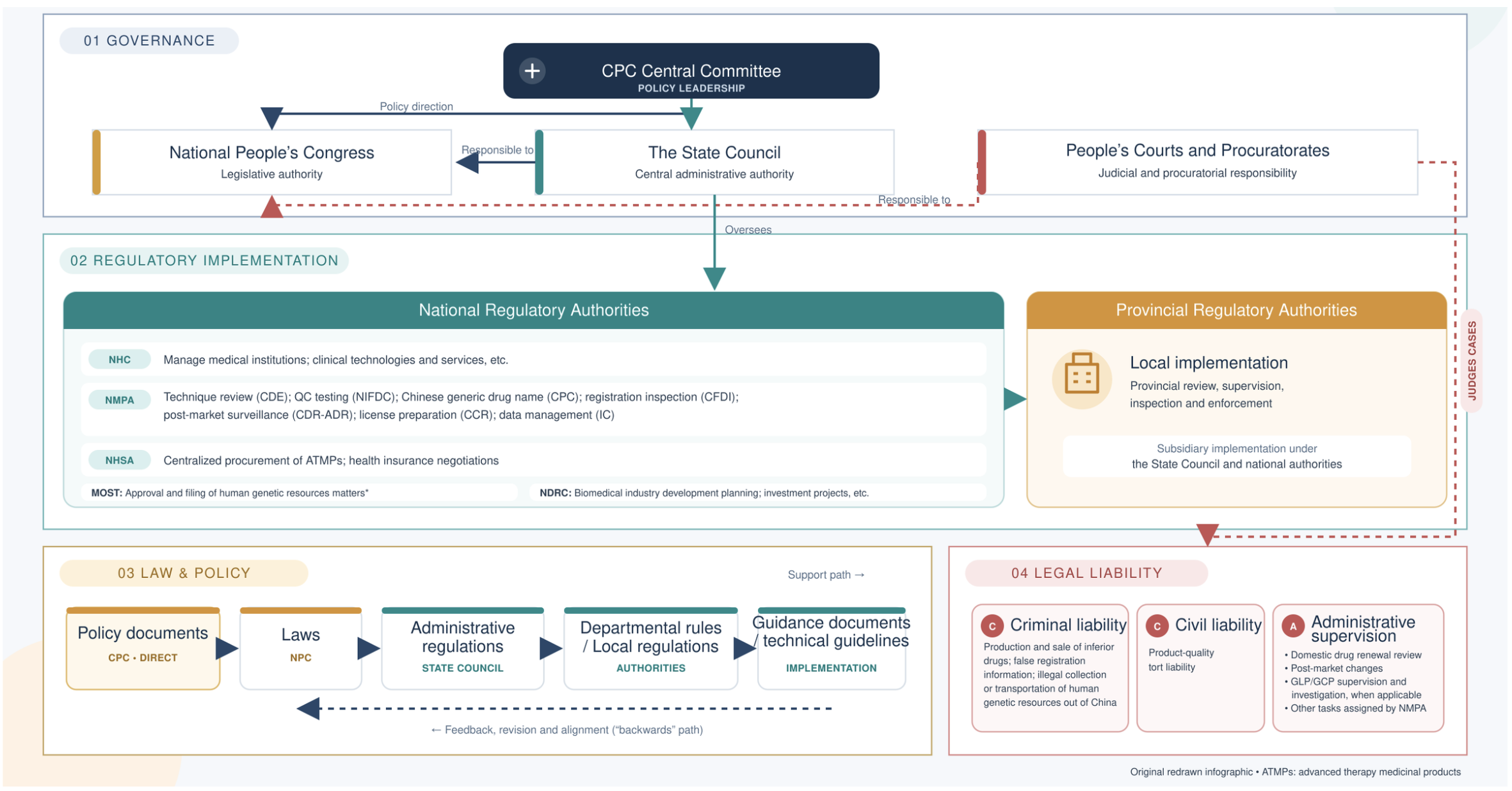
Figure 2. China’s regulatory administration framework of ATMPs [3].
Requirements for clinical research
Order No. 818 establishes specific institutional and procedural requirements. A clinical-research sponsor must be a legal person established in China, while the institution implementing the research must generally be a tertiary Grade A medical institution with qualified academic and ethics committees, appropriate facilities, trained personnel, research capability, management systems, and stable funding [10].
Before human research begins, sufficient laboratory and animal investigations must support the proposed technology. The research must undergo both academic and ethical review, after which the clinical institution must file the study with the national health authority within five working days. Filing is not equivalent to an unconditional authorization: the health authority may assess a filed project and require modification, suspension, or termination when technical or ethical risks are identified [10].
The regulation strengthens participant protections. Written informed consent is required, and information must be presented in a manner understandable to participants or their legal representatives. Sponsors and research institutions may not charge participants fees related to the clinical research. Research records and source materials must generally be retained for 30 years after completion; records involving offspring must be retained permanently. Serious adverse reactions may require suspension and ethical reassessment, and long-term follow-up is required to evaluate safety and effectiveness [10].
These provisions provide a more explicit legal basis for responsibilities previously addressed through trial measures, ethical rules, administrative guidance, and institutional requirements. They also introduce substantial administrative, financial, and professional penalties for unfiled research, unauthorized clinical application, failure to obtain informed consent, data falsification, and other violations.
Clinical translation and controlled application
A biomedical new technology cannot enter routine clinical use solely because a filed research project has been completed. Clinical translation requires approval from the National Health Commission. The application must include the research report and records, proposed indications, adverse reactions, contraindications, institutional and professional qualifications, operating procedures, and risk-control measures [10].
The 2026 approval specification adds that the technology must have demonstrated safety, effectiveness, and ethical acceptability. It must also have been implemented independently in a multicenter setting according to a common operating procedure, with consistent safety and effectiveness conclusions [12].
This requirement is intended to demonstrate that the intervention is technically mature, reproducible, and not dependent exclusively on the expertise of a single institution.
Following approval, qualified medical institutions may apply the technology in accordance with the published operating requirements and may charge fees as permitted by applicable rules. Clinical application remains subject to reporting, risk management, surveillance, and re-evaluation. Approval can be suspended or withdrawn when new evidence changes the assessment of safety or effectiveness or when serious and uncontrollable risks emerge [10,12].
Remaining challenges
The 2026 regulation addresses a long-standing need for a clearer legal pathway for highly individualized and institution-dependent biomedical technologies. It establishes enforceable requirements extending from clinical research to controlled clinical translation. Nevertheless, several issues will require observation as the system is implemented.
First, the practical boundary between a “technology” and a “product” may remain difficult for rapidly evolving or partially standardized interventions. Manufacturing models can change during development, and an initially individualized intervention may later become scalable. Continuous coordination between health and drug authorities will therefore be essential.
Second, filing should not be interpreted as a reduced scientific standard. Investigator-initiated studies must generate reliable, traceable, and clinically interpretable data. Published analyses have highlighted large differences between investigator-initiated and industry-sponsored cell therapy studies in China [4]. Strong protocol design, prospective registration, validated manufacturing controls, independent monitoring, transparent reporting, and appropriate statistical analysis remain necessary.
Third, long-term follow-up and post-application surveillance must be sufficiently detailed for therapies with persistent or irreversible effects. The collection of standardized long-term safety data, management of delayed adverse events, traceability of starting materials, and linkage between institutional and national safety systems will be especially important for gene-modified and stem-cell interventions [3,9].
Finally, the impact of Order No. 818 cannot yet be evaluated conclusively. The regulation entered into force only on May 1, 2026, and peer-reviewed literature published before that date necessarily describes the preceding system.
Claims regarding improved efficiency, patient access, innovation, or safety should therefore be presented as regulatory objectives rather than established outcomes until implementation data become available.
Conclusion
China’s cell and gene therapy framework has progressed from fragmented oversight toward a more structured system combining product regulation with a legally defined biomedical-technology pathway. The drug pathway remains the principal route for standardized cell and gene therapy products intended for manufacturing and marketing. The new-technology pathway provides a separate route for selected highly individualized or rare-disease technologies that do not fit conventional product development.
The 2026 regulation should not be characterized as deregulation or as a general alternative to drug approval. It introduces institutional qualifications, filing, academic and ethical review, participant protections, long-term follow-up, approval before clinical translation, ongoing supervision, and significant legal liability. Its long-term significance will depend on clear classification, consistent implementation, high-quality clinical evidence, coordination between authorities, and transparent post-application monitoring.
References
- Wu W, Wang Y, Tang Z, Gao Y, Huo Y. Regulatory oversight of cell-based therapy in China: government’s efforts in patient access and therapeutic innovation. Pharmacol Res. 2020;158:104889. doi:10.1016/j.phrs.2020.104889.
- Lu J, Xu L, Wei W, He W. Advanced therapy medicinal products in China: regulation and development. MedComm. 2023;4(3):e251. doi:10.1002/mco2.251.
- Shi J, Chen X, Hu H, Ung COL. The evolving regulatory system of advanced therapy medicinal products in China: a documentary analysis using the World Health Organization Global Benchmarking Tool standards. Cytotherapy. 2024;26(8):954–966. doi:10.1016/j.jcyt.2024.04.070.
- Du X, Luo X, Liu L, Cao Y, Zhang Y, Zhang Y. Mapping the cell therapy landscape: insights into clinical trials and regulatory advances in China. J Hematol Oncol. 2024;17(1):96. doi:10.1186/s13045-024-01616-8.
- National Health and Family Planning Commission; China Food and Drug Administration. Administrative Measures for Stem Cell Clinical Research (Trial). Guo Wei Ke Jiao Fa No. 48; 2015.
- China Food and Drug Administration. Technical Guideline for Research and Evaluation of Cell Therapy Products (Trial). Beijing: CFDA; 2017.
- Center for Drug Evaluation, National Medical Products Administration. Technical Guideline for Clinical Trials of Immune Cell Therapy Products (Trial). Beijing: CDE; 2021.
- Center for Drug Evaluation, National Medical Products Administration. Technical Guideline for Nonclinical Research and Evaluation of Gene Therapy Products (Trial) and Technical Guideline for Nonclinical Research of Genetically Modified Cell Therapy Products (Trial). Beijing: CDE; 2021.
- Cai Y, Sui L, Wang J, Qian W, Peng Y, Gong L, et al. Post-marketing surveillance framework of cell and gene therapy products in the European Union, the United States, Japan, South Korea and China: a comparative study. BMC Med. 2024;22:421. doi:10.1186/s12916-024-03637-z.
- State Council of the People’s Republic of China. Administrative Regulation on Clinical Research and Clinical Translation of New Biomedical Technologies. State Council Order No. 818. Promulgated September 28, 2025; effective May 1, 2026.
- National Health Commission; National Disease Control and Prevention Administration. Announcement on matters concerning implementation of the Administrative Regulation on Clinical Research and Clinical Translation of New Biomedical Technologies. Announcement No. 4 of 2026. April 30, 2026.
- National Health Commission of the People’s Republic of China. Specification for Approval of Clinical Translation and Application of New Biomedical Technologies (Trial). Guo Wei Ke Jiao Fa No. 13 of 2026. April 30, 2026.


Leave a Reply