Yueh-Tung Tsai, Wen-Hsiu Chiu, Chia-ping Liu, & Chih-Kang Chiang
Taiwan Food and Drug Administration
Ministry of Health and Welfare, Taiwan
Corresponding Email:
yttsai@fda.gov.tw; wenhsiu@fda.gov.tw; meat0901@fda.gov.tw; ckchiangtfda@fda.gov.tw
Abstract
Due to rapid development of biotechnology in recent years, the field of regenerative medicine has attracted considerable attention. On June 4th 2024, the Taiwan Legislative Yuan passed the“Regenerative Medicine Act” and the “Regenerative Medicinal Products Act”, and the Taiwan Executive Yuan announce both of the Act enforce On January 1 2026. These changes aim to ensure the safety, quality, and effectiveness of regenerative medicine, and to protect patients’ rights to receive treatment and give the development of Taiwan’s biomedical industry a shot in the arm.
Introduction
The field of regenerative medicine is a new area for pharmaceutical management. There are different regulatory framework for regenerative medicine in advanced countries worldwide as well as Taiwan.
Regenerative medicine related regulations have been established in several countries to ensure the quality, safety and efficacy of innovative treatments. Considering the diversity of regenerative medicine, the regulatory framework in Taiwan have been adjusted in response to global trend and local demand. Before 2010, cell and gene therapies were regarded as “new medical practice” under the “Medical Care Act”. Along with the establishment of Taiwan Food and Drug Administration (TFDA) in 2010, regenerative medicine was regulated as “medicinal products” under the “Pharmaceutical Affairs Act”. Then, the Ministry of Health and Welfare (MOHW) established a new dual-track regulatory pathway for regenerative medicine in 2016. The dual-track pathway divided regenerative medicine into medical practices and medicinal products
This paper aims to describe the new regulatory framework of the “Regenerative Medicine Act” and the “Regenerative Medicinal Products Act” to promote the quality of regenerative medicine and ensure patients’ safety in Taiwan.
New Regulatory Framework for Regenerative Medicine
The New regulatory framework: two Acts of Regenerative Medicine
Those two special events were deemed as a turning point for the regulatory framework transformation to accelerate regenerative medicine innovation and enhance patient access. New acts for regenerative medicine were enforced on January 1st 2026. The two new acts, the “Regenerative Medicine Act” and the “Regenerative Medicinal Products Act,” are legislated based on scientific evidence. The comparison of two acts is summarized in Fig. 1.
The establishment of the new regenerative medicine acts not only aims to refine the regulation and reinforce the management system, but also assist to expedite the approval and accelerating patient access to innovative regenerative medicine in Taiwan.
The Regenerative Medicine Act
The establishment of the Regenerative Medicine Act is to strengthen the supervision of regenerative medicine therapies in medical institutions, as well as the cell processing procedures in the cell processing unit(CPU). Regenerative Medicine Act regulates multiple aspects of regenerative medicine therapies, including, e.g., the scope of regenerative medicine therapies, qualification-
of physicians and cell processing technicians, CPU quality management, cell and tissue donor related regulations and relief measures, which intensifies the quality management of regenerative medicine therapies and provides safe medical care to the patients.
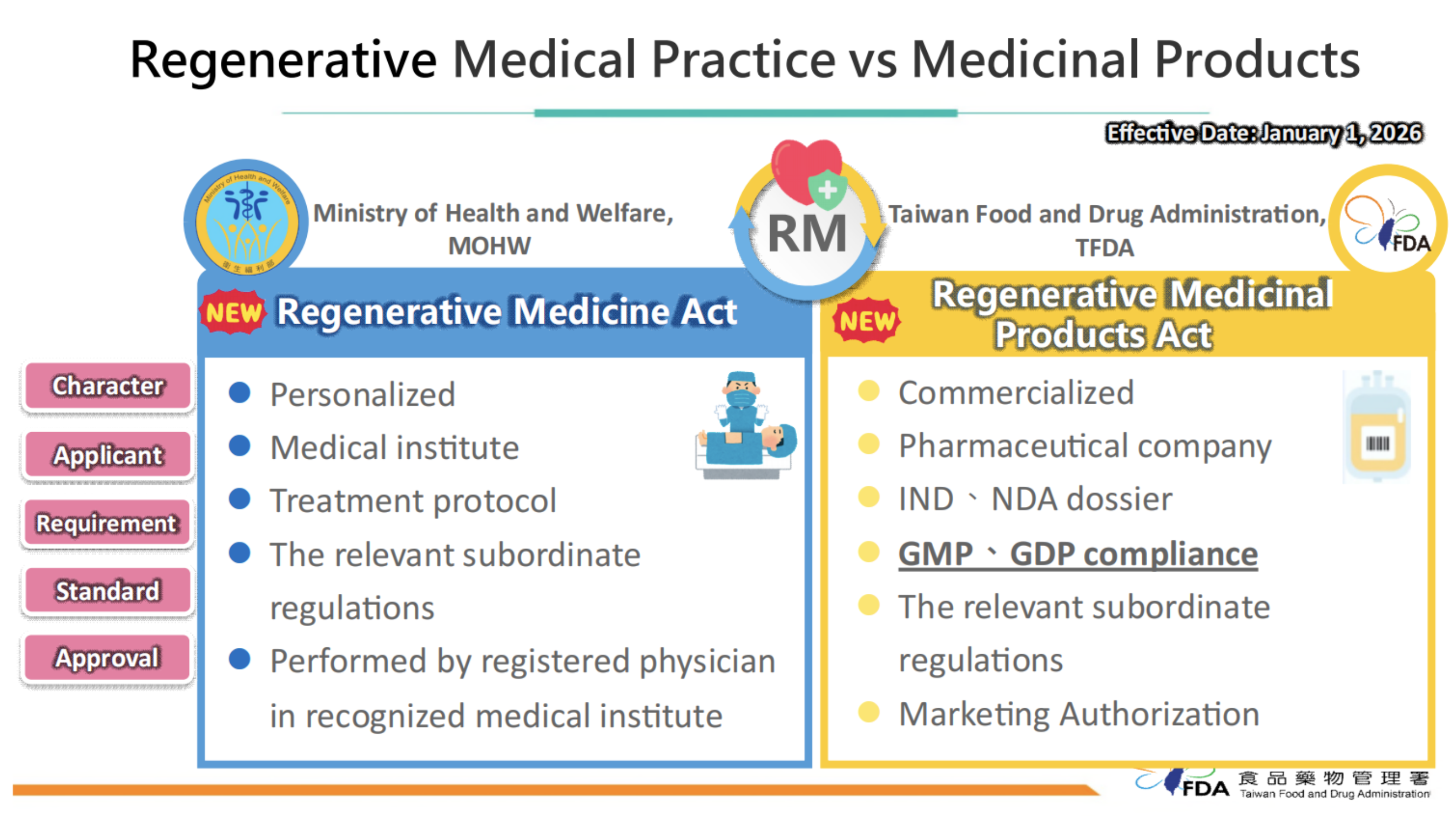
Figure 1. Comparison of two acts
The Regenerative Medicinal Products Act
The regenerative medicine provides unprecedent potential to cure previously intractable diseases such as cancers and genetic disorders. Living somatic cells as active ingredients had been reported to treat diseases, such as modified immune T cells treating acute lymphocytic leukemia. Prevention of contamination, transmission of infectious diseases during manufacture process needs to be taken into considerations due to the characteristics of living cells. To ensure patients’ safety, it is necessary to construct specific regulatory framework for regenerative medicinal products. Specifically, the determination of donor eligibility, donor informed consents, donor recruitment advertisement, as well as the management of traceability are not addressed in the “Pharmaceutical Affairs Act”. Thus, the Regenerative Medicinal Products Act serves as the specific law for the Pharmaceutical Affairs Act to strengthen the management. The Act covers whole lifecycle management of regenerative medicinal products and consists of six sections such as general provision, product registration, conditional approval, manufacture and distribution, post-approval management and penalties, the framework of “Regenerative Medicinal Products Act” is summarized in Fig. 2.
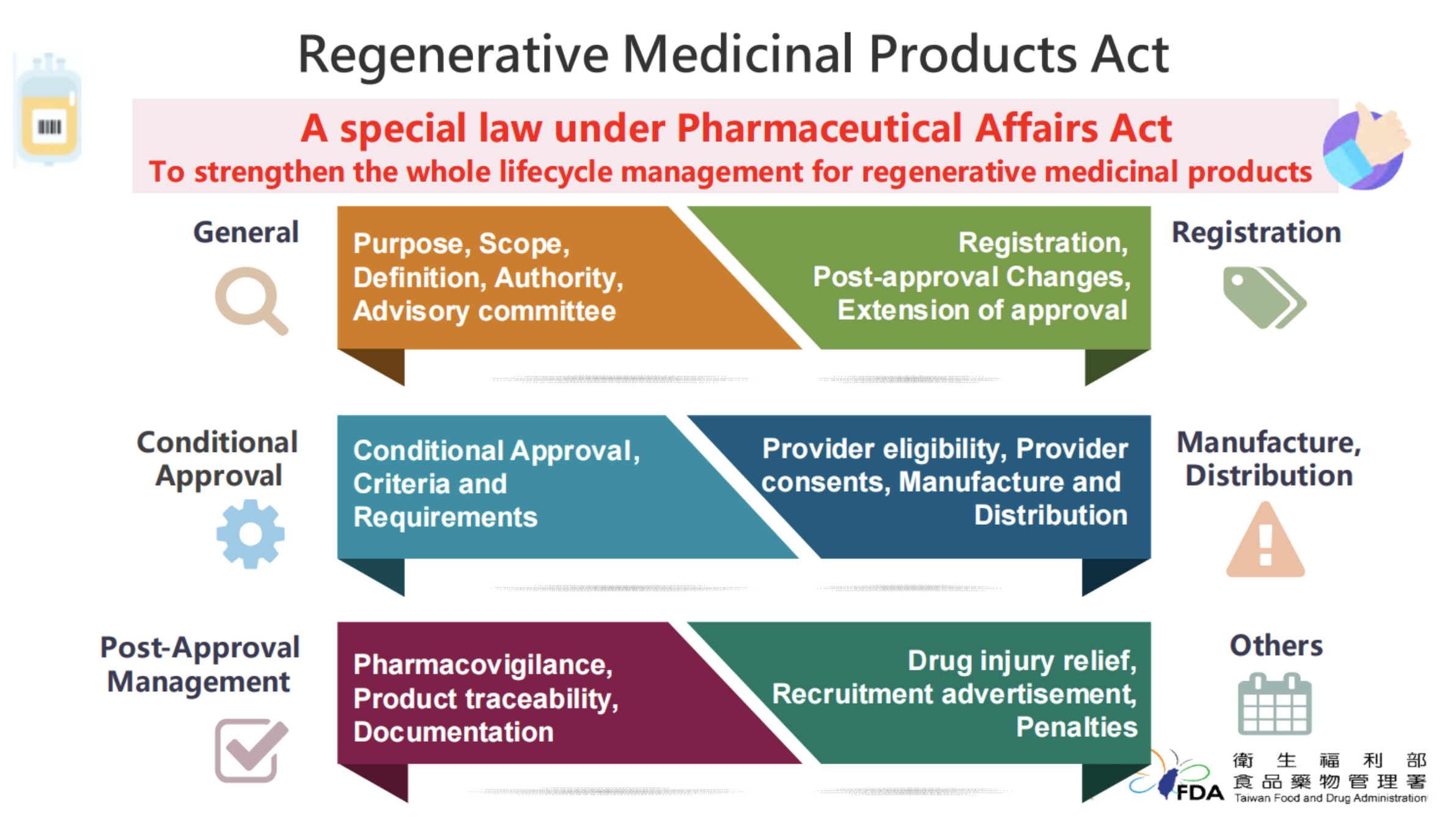
Figure 2. The framework of “Regenerative Medicinal Products Act“
General Provision
The purpose and scope of the Act, the competent authority, definition of regenerative medicinal products, and qualification of pharmaceutical firms are regulated in this section. According to the definition, the regenerative medicinal products are classified into four types based on their unique characteristics, which are gene therapy products, cell therapy products, tissueengineered products and combination products.
Product Registration
The registration requirements for regenerative medicinal products are the same as those of biological products. A regenerative medicinal product shall be granted marketing authorization and get a drug product license before it can be used in patients. Post-market variations and extension of drug product license shall be implemented with prior approval, and use the “Regulations for Registration and Permission of Regenerative Medicinal Products” as supporting measures.
Conditional Approval
Conditional approval for regenerative medicinal products is new in the Act. It offers opportunities for patients with life-threatening and severe disability diseases to have earlier access to innovative regenerative medicinal products. A regenerative medicinal product that is used to treat life-threatening diseases might be granted conditional approval with confirmed safety and preliminary efficacy. Besides, additional requirements will be imposed and shall be completed within a limited time frame to ensure patients’ rights.
Manufacture and Distribution
The manufacturer shall ensure the donor eligibility and obtain consents from cell donors before collecting the sample of the regenerative medicinal products, and use the“Regulations on the Eligibility Determination of Human Cell and Tissue Donors for Regenerative Medicinal Products” as supporting measures. The items of donor consent information and the way of informed consent are regulated in the act, and use the“Regulations on Informed Consent of Those Who Provide Their Tissues or Cells for Regenerative Medicinal Products” as supporting measures, the cell donors should be recruited by pharmaceutical companies only. Moreover, the donor recruitment advertisements shall be reviewed and approved, and use the “Regulations Governing Publication of Regenerative Medicinal Tissue and Cell Provider Recruitment Advertisement” as supporting measures. As for the manufacture and distribution of regenerative medicinal products, it should meet the standards of PIC/S GMP and Good Distribution Practice (GDP), and shall obtain a manufacturing and distribution license.
Post-Approval Management
To ensure consistency and quality of regenerative medicine after marketing approval, the requirement of pharmacovigilance use the “ Regulations on the Safety Surveillance of
Regenerative Medicinal Products” as supporting measures. Besides, product traceability and drug injury relief are regulated in the act, and use the“Regulations on Traceability and
Tracking for Regenerative Medicinal Products” as supporting measures. Moreover, the case of money be paid use the“Fee-charging Standards for Regenerative Medicinal Products” as supporting measures.
Penalties
The penalties about non-compliance with the draft act are stated.
The future of Regenerative Medicine
Looking ahead, with the enforcement of the “ Regenerative Medicine Act” and the “Regenerative Medicinal Products Act”, regenerative medicine is set to continue becoming a key focus in healthcare and biotechnology policy. The Taiwan Food and Drug Administration is developing a dedicated support program for regenerative medicinal products, will guide industry-academia-research collaborations, aiming to provide case-specific regulatory consultation and support and accelerate the development of domestically products, we will continuously monitor the implementation and enforcement of regulations, and, by referencing international trends, make iterative adjustments to the regulations. Through proactive promotion of related policies, it is hoped that regenerative medicine will achieve new milestones.
Conclusion
Regenerative medicine represents an important innovation in the treatment of unmet medical needs. In order to further refine the regulatory framework for regenerative medicine, the “Regenerative Medicine Act” and the “Regenerative Medicinal Products Act” were enforced on January 1 2026. We believe that the promulgation of the two new Acts will enhance the regulatory infrastructure of regenerative medicine, foster the research and development of regenerative medicine, reinforce the management system and increase patient accessibility in Taiwan.
References
- Pharmaceutical Affairs Act (2011). https://lis.ly.gov.tw/lawsingleusr/00043/download.htm?539600006 (Amended 22 NOV 2011)
- Regulations of Good Manufacturing Practice (GMP) (2013). https://law.moj.gov.tw/ENG/LawClass/LawAll.aspx?pcode=L0030073 (Amended 30 Jul 2013)
- Regulations for Registration of Medicinal Products(2010) https://law.moj.gov.tw/LawClass/LawOldVer.aspx?pcode=L0030057&lnndate=2010120 9&lser=001 (Amended 9 Dec 2010)
- Pharmaceutical Affairs Act (2018). https://law.moj.gov.tw/ENG/LawClass/LawAll.aspx?pcode=L0030001 (Amended 31 Jan 2018)
- Regenerative Medicine Act https://law.moj.gov.tw/ENG/LawClass/LawAll.aspx?pcode=L0020238 (Announced 19 Jun 2024)
- Regenerative Medicinal Products Act https://law.moj.gov.tw/ENG/LawClass/LawAll.aspx?pcode=L0030142 (Announced 19 Jun 2024)
- PIC/S Good Distribution Practice (GDP) https://law.moj.gov.tw/ENG/LawClass/LawAll.aspx?pcode=L0030086 (Announced 28 Dec 2017)
- Regulations on the Safety Surveillance of Regenerative Medicinal Products https://law.moj.gov.tw/ENG/LawClass/LawAll.aspx?pcode=L0030143 (Announced 25 Aug 2025)
- Regulations on Traceability and Tracking for Regenerative Medicinal Products https://law.moj.gov.tw/ENG/LawClass/LawAll.aspx?pcode=L0030144 (Announced 28 Oct 2025)
- Regulations Governing Publication of Regenerative Medicinal Tissue and Cell Provider Recruitment Advertisement https://law.moj.gov.tw/LawClass/LawAll.aspx?pcode=L0030145&kw=%e5%86%8d%e7%94%9f%e9%86%ab%e7%99%82%e8%a3%bd%e5%8a%91 (Announced 11 Nov 2025)
- Regulations on Informed Consent of Those Who Provide Their Tissues or Cells for Regenerative Medicinal Products https://law.moj.gov.tw/LawClass/LawAll.aspx?pcode=L0030146&kw=%e5%86%8d%e7%94%9f%e9%86%ab%e7%99%82%e8%a3%bd%e5%8a%91 (Announced 1st Dec 2025)
- Regulations on the Eligibility Determination of Human Cell and Tissue Donors for Regenerative Medicinal Products https://law.moj.gov.tw/LawClass/LawAll.aspx?pcode=L0030148&kw=%e5%86%8d%e7%94%9f%e9%86%ab%e7%99%82%e8%a3%bd%e5%8a%91 (Announced 9 Dec 2025)
- Regulations for Registration and Permission of Regenerative Medicinal Products https://law.moj.gov.tw/LawClass/LawAll.aspx?pcode=L0030147&kw=%e5%86%8d%e7%94%9f%e9%86%ab%e7%99%82%e8%a3%bd%e5%8a%91 (Announced 4 Dec 2025)
- Fee-charging Standards for Regenerative Medicinal Products https://law.moj.gov.tw/LawClass/LawAll.aspx?pcode=L0030149&kw=%e5%86%8d% e7%94%9f%e9%86%ab%e7%99%82%e8%a3%bd%e5%8a%91 (Announced 29 Dec 2025)
 THE ACTO TIMES
Leave a comment